Picture this: it’s a Saturday morning at the lake, and your family of four is standing on the dock staring at a single 10-foot paddleboard. The kids want to stand on it together. Your partner wants to try a few yoga poses. You just want to paddle without falling in every five minutes. A standard, narrow racing board — think a slender 28-inch-wide plank built for speed — would dump everyone into the water within sixty seconds. What you actually need is a wide-body inflatable SUP: a stand-up paddleboard (a flat, buoyant platform you stand on while using a long paddle to propel yourself) that prioritizes stability and usable deck space over straight-line speed. Inflatable versions are made from military-grade PVC (a tough, layered plastic) that packs down into a rolling duffel, making them practical for families without a truck or a garage full of racks. This guide will walk you through what makes a wide-body iSUP worth buying, how the leading options stack up, and how to match the right board to how you actually plan to use it.
| EDITOR'S PICKSkatinger 11'6×35" Super Wide I… | Mid-tierZLX 11'6"x35" Ultra Wide Inflat… | Budget pick[Roc Inflatable Stand Up Paddle…](https://www.amazon.com/dp/B0FDR83FMF?tag=greenflower20-20) | |
|---|---|---|---|
| Length | 11'6" | 11'6" | 10'6" |
| Width | 35" | 35" | — |
| Weight Capacity | 450lb | — | — |
| Deck Pad | — | Non-Slip | Non-Slip |
| Backpack Included | ✓ | ✓ | — |
| Fin System | — | Unique | — |
| Price | $279.99 | $219.99 | $199.99 |
| See on Amazon → | See on Amazon → | See on Amazon → |
Why Width Is the Variable That Changes Everything
In the SUP world, width is your primary lever for stability. The REI Co-op Learning Center’s paddleboarding buying guide explains the relationship plainly: a board’s width — measured at its widest point — directly determines how much lateral (side-to-side) tipping resistance it offers, especially when a paddler shifts weight or a second person climbs aboard.
Here’s the general breakdown the industry has settled on:
- 28–30 inches wide: All-around boards designed for a single adult. Reasonably stable for most beginners, but limited for multi-person use or yoga flows that involve kneeling and standing transitions.
- 31–33 inches wide: The sweet spot for yoga practitioners, heavier paddlers, and families. Enough deck real estate for two kids sitting side by side, or for holding a Warrior III without your heart rate spiking.
- 34–36 inches wide: Dedicated yoga and lounge boards. Extremely stable, but slower and harder to track in a straight line. Best for calm flatwater; you’ll feel the drag on any open-water paddle longer than 20 minutes.
Paddling Magazine’s “How to Choose a Stand-Up Paddleboard” reinforces that novice paddlers lose confidence quickly when a board feels twitchy, which increases the width argument for beginners: a stable platform isn’t just more comfortable, it’s the difference between someone who tries the sport twice and someone who sticks with it for years.
The Thickness Factor (Often Overlooked)
Width gets most of the attention, but board thickness matters nearly as much for family and yoga use. The industry standard for quality iSUPs is 6 inches of thickness, which gives the board enough rigidity (once fully inflated to the manufacturer-recommended PSI, typically 12–15 PSI) that it doesn’t flex or “banana” under weight. Thinner 4-inch boards are lighter and cheaper but noticeably softer under a heavier load — something owners consistently mention in long-run forum reviews when comparing entry-level boards to mid-tier options.
What the Numbers Actually Mean: A Quick Reference
| Use Case | Ideal Width | Ideal Length | Weight Limit Range |
|---|---|---|---|
| Solo beginner / flatwater | 30–32 in | 10–11 ft | 250–300 lbs |
| Yoga / fitness | 31–34 in | 10–11 ft | 250–350 lbs |
| Two kids + one adult | 33–36 in | 11–12 ft | 350–500 lbs |
| SUP fishing / gear storage | 32–34 in | 11–12 ft | 350–450 lbs |
Weight limits are manufacturer-rated figures, not independently verified. Paddling near the top of a rated limit noticeably reduces freeboard (how high the deck sits above the waterline) and increases instability.
The Board Categories Worth Comparing
Entry-Level Wide-Body iSUPs ($350–$550)
This tier covers boards from brands like Roc, SereneLife, and Atoll. Wirecutter’s paddle board guide notes that the Atoll 11’0” has become a consistent reference point in this price range — it’s 32 inches wide, 6 inches thick, and rated for 300 pounds, with a construction quality (drop-stitch core with dual-layer PVC rails) that punches above its price. Owners report that inflation to the recommended 15 PSI takes 10–12 minutes with the included hand pump and that the board tracks acceptably straight with the included center fin.
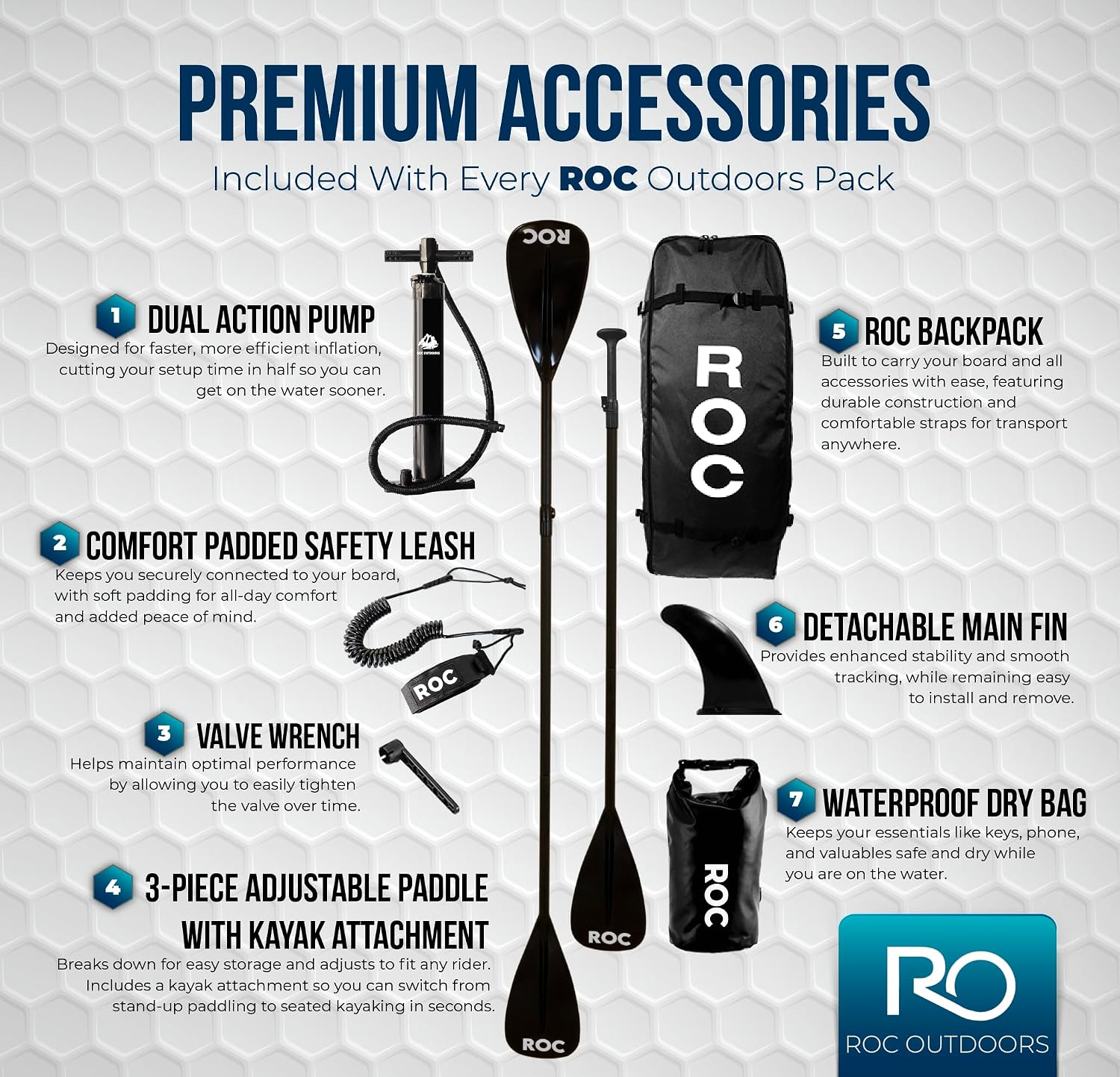
The tradeoff at this price point is accessory quality. Included paddles are typically aluminum or low-grade fiberglass — functional, but heavy enough that you’ll notice arm fatigue on paddles over 45 minutes. The leash (the safety cord that attaches the board to your ankle so it doesn’t drift away if you fall) and pump quality also vary. Buyers planning to use these boards seriously, more than 15–20 sessions per season, should budget $60–$120 for a fiberglass or carbon-fiber paddle upgrade.
If X, then Y: If you’re buying for occasional use — a few lake weekends per summer, maybe a kid trying the sport before committing — the entry-level tier gives you 90% of the stability of pricier boards at roughly half the cost.
Mid-Tier Performance Wide-Body iSUPs ($550–$950)
This is where most serious buyers land. Brands like iRocker, Red Paddle Co., Bluefin, and Tower Paddleboards dominate the segment. Outside Online’s roundup of the best inflatable paddleboards consistently highlights iRocker’s ULTRA and CRUISER lines for their dual-chamber construction — a secondary internal air bladder that adds redundancy if the outer shell is punctured — and higher-quality accessory packages including carbon-shaft adjustable paddles.
Red Paddle Co., a UK-based brand with significant U.S. distribution, is frequently cited by gear reviewers for build quality: their MSL Fusion lamination process bonds the PVC layers differently than standard glued construction, which owners in multi-year reviews describe as producing a board that feels more rigid and holds its shape better over time. Their Yoga board (10’8” x 33”) is explicitly designed for on-water practice, with a full-deck EVA foam pad (the non-slip textured surface that covers most of the board) and a center carry handle positioned for balance rather than just transport.
Gear Junkie’s long-form iSUP comparison notes that mid-tier boards in this segment typically ship with dual-action pumps (which inflate on both the push and pull strokes, cutting inflation time roughly in half) and electric pump compatibility — worth noting for families who don’t want to arrive at the water already winded.
By the numbers:
- Entry-tier board: ~$450 + $80 paddle upgrade = ~$530 all-in
- Mid-tier board with quality accessories included: ~$700–$850
- Cost difference: $170–$320
For anyone planning 25+ sessions per year, the mid-tier package often represents better cost-per-use math, particularly because the included carbon paddle alone would cost $90–$120 purchased separately.
Premium and Specialized Wide-Body iSUPs ($950–$1,500+)
At the top of the inflatable market sit boards from Red Paddle Co.’s Activ and Ride lines, BOTE’s BREEZE Aero series, and Starboard’s Yoga range. Starboard, a brand with deep roots in competitive SUP racing, has applied its construction expertise to wide-body recreational boards — their iGO Zen is 34 inches wide with a 6-inch profile and rated for 330 pounds, and reviewers consistently note the stiffness-to-weight ratio as noticeably better than boards at half the price.
BOTE’s BREEZE Aero 11’6” (32 inches wide) is frequently positioned as a crossover board: stable enough for yoga and casual family paddling, but capable enough as a touring board that an intermediate paddler won’t feel limited by it in two or three seasons. Paddling Magazine’s buying guide places boards like this in the “grow-into” category — gear that doesn’t become obsolete as your skill level advances.
The honest tradeoff at this tier: you’re paying a significant premium for incremental improvements in rigidity, accessory quality, and brand support (warranty service, replacement parts availability). For purely casual use, the jump from $800 to $1,400 rarely justifies itself. For someone who plans to SUP seriously — multiple times per week, longer paddles, eventual yoga instruction — the quality ceiling matters.
Features to Prioritize (And Two You Can Ignore)
Prioritize These
Full-deck EVA padding. Yoga and family use means people sitting, kneeling, lying down, and dropping a water bottle. A full-deck pad (covering 80–100% of the top surface) makes all of this dramatically more comfortable and safer. Partial pads — common on entry-level boards — leave slippery PVC exposed at the nose and tail.
D-ring count and placement. D-rings are the small metal attachment loops on the deck. A board intended for families or gear-hauling should have at least 8, positioned at the nose, tail, and mid-deck for bungee cargo storage. Yoga boards specifically benefit from side D-rings for optional anchor lines in moving water.
Dual-chamber construction. Increasingly common at mid-tier and above. This isn’t marketing: if a seam fails or the valve sticks mid-session, a single-chamber board deflates completely. A dual-chamber board holds enough air to return to shore safely. Paddling Magazine explicitly recommends this feature for any buyer planning open-water or unsupervised use.
Fins. Most iSUPs ship with a three-fin setup: one large center fin and two smaller fixed side fins. The center fin is usually removable and swappable — important because a wider, flexible fin tracks better in flatwater while a smaller fin reduces drag if you’re paddling in shallow areas. Boards that include both fin sizes (or a US fin box that accepts after-market fins) give you more versatility.
Skip These (Usually)
Seat attachments and kayak conversion kits. Marketed heavily at beginners, but owners consistently report they make a wide board feel awkward and are rarely used after the first month.
Included waterproof phone cases. These are almost universally poor quality at the price points where they’re offered. Budget for a purpose-built waterproof case or a chest-mount action camera mount instead.
The Decision Framework
If you’re standing at the fork right now, here’s a clean decision rule:
- First-time buyer, one or two adults, casual lake use: An entry-level 32-inch board in the $450–$550 range, plus a $80–$100 fiberglass paddle upgrade. Spend the money you save on a quality leash and a board bag.
- Family with young kids, or yoga-primary use: Move to a 33–34 inch board from the mid-tier segment ($700–$850). The stability difference is real and persistent, and the included accessories will actually last.
- Serious practitioner, yoga instruction, multi-season commitment, or open-water ambitions: Budget $950–$1,400 for a premium board. Red Paddle Co. and Starboard are the names reviewers return to most reliably in this tier. You’ll notice the difference; the question is whether your use case justifies it.
One thing worth flagging clearly: iSUP technology has improved significantly in the last three years, but the market also has no shortage of low-quality boards with impressive-sounding spec sheets and poor quality control. Stick to brands with documented U.S. warranty support and replacement part availability — the leash plug, valve, and fin box are the three most common failure points, and boards from brands without U.S. service infrastructure can become expensive decorations when something breaks.
The water’s warmer than it looks. Pick the board that makes you actually want to get on it.