Picture this: you’ve just parked a quarter-mile from your campsite — the good one, the one with the fire ring and the view — and you’re staring at a 65-quart cooler packed with three days of food and two bags of ice. It weighs somewhere north of 70 pounds. There’s a gravel path, then a stretch of packed dirt, then about 30 feet of actual grass. The little plastic wheels on your old cooler? They snapped last summer. This guide exists for that exact moment.
A wheeled cooler is exactly what it sounds like — a hard-sided insulated box (the kind that keeps ice frozen for days, not hours) mounted on wheels with a telescoping or fixed handle, so you can roll it instead of carrying it. The difference between a cooler that “has wheels” and one that actually rolls on gravel comes down to wheel diameter, axle construction, and whether the chassis (the structural frame of the box itself) was built to absorb vibration and impact. This guide breaks down what separates the pretenders from the workhorses across four price tiers, names the tradeoffs explicitly, and gives you a clear decision rule at the end.
| EDITOR'S PICK[RTIC 45 QT Wheeled Ultra-Tough](https://www.amazon.com/dp/B0D8R5FSXW?tag=greenflower20-20)… | Mid-tier[Igloo Maxcold Glide 110Qt Wheel](https://www.amazon.com/dp/B004XUNDX4?tag=greenflower20-20)… | Budget pick[Coleman Xtreme Rolling Cooler](https://www.amazon.com/dp/B00BYDG3BM?tag=greenflower20-20) w… | |
|---|---|---|---|
| Capacity | 45 QT | 110 QT | — |
| Ice Retention | — | — | 5 Days |
| Insulation Type | Rotomolded | — | Extra-walled |
| Price | $247.99 | $139.99 | $54.99 |
| See on Amazon → | See on Amazon → | See on Amazon → |
Why Wheels Fail — and What Good Ones Actually Look Like
Most wheeled coolers sold below the $80 mark use injection-molded plastic wheels — the same material as the cooler body, stamped out cheaply and attached on a thin axle. They’re fine on concrete. On gravel, they fracture, sink, or spin out because the contact patch (the surface area touching the ground) is too narrow and the wheel diameter is too small to roll over obstacles without transferring the full shock into the axle mount.
Wirecutter’s cooler coverage notes that wheel diameter is the single most predictive spec for off-pavement performance: wheels under 5 inches in diameter struggle on loose gravel and won’t clear roots or ruts reliably. Wheels 6 inches and above — especially those made from rubber-over-plastic or full rubber — roll over gravel with meaningfully less effort and far fewer stress fractures over time.
There’s also the question of cooler construction. Rotomolded coolers — where the body is formed by spinning liquid plastic in a mold to create a seamless, single-wall shell — are heavier but substantially more rigid than injection-molded models (made by injecting plastic into a two-part mold, leaving seams). That rigidity matters when you’re dragging 70 pounds across uneven terrain; a flexible body torques and stresses the wheel mounts from the inside. Outside Online’s 2025 cooler roundup specifically calls out chassis flex as the primary failure mode in cheaper wheeled models when loaded heavily.
The Four Tiers: What You Get at Each Price Point
Budget tier ($50–$120): Roll-able, but carefully
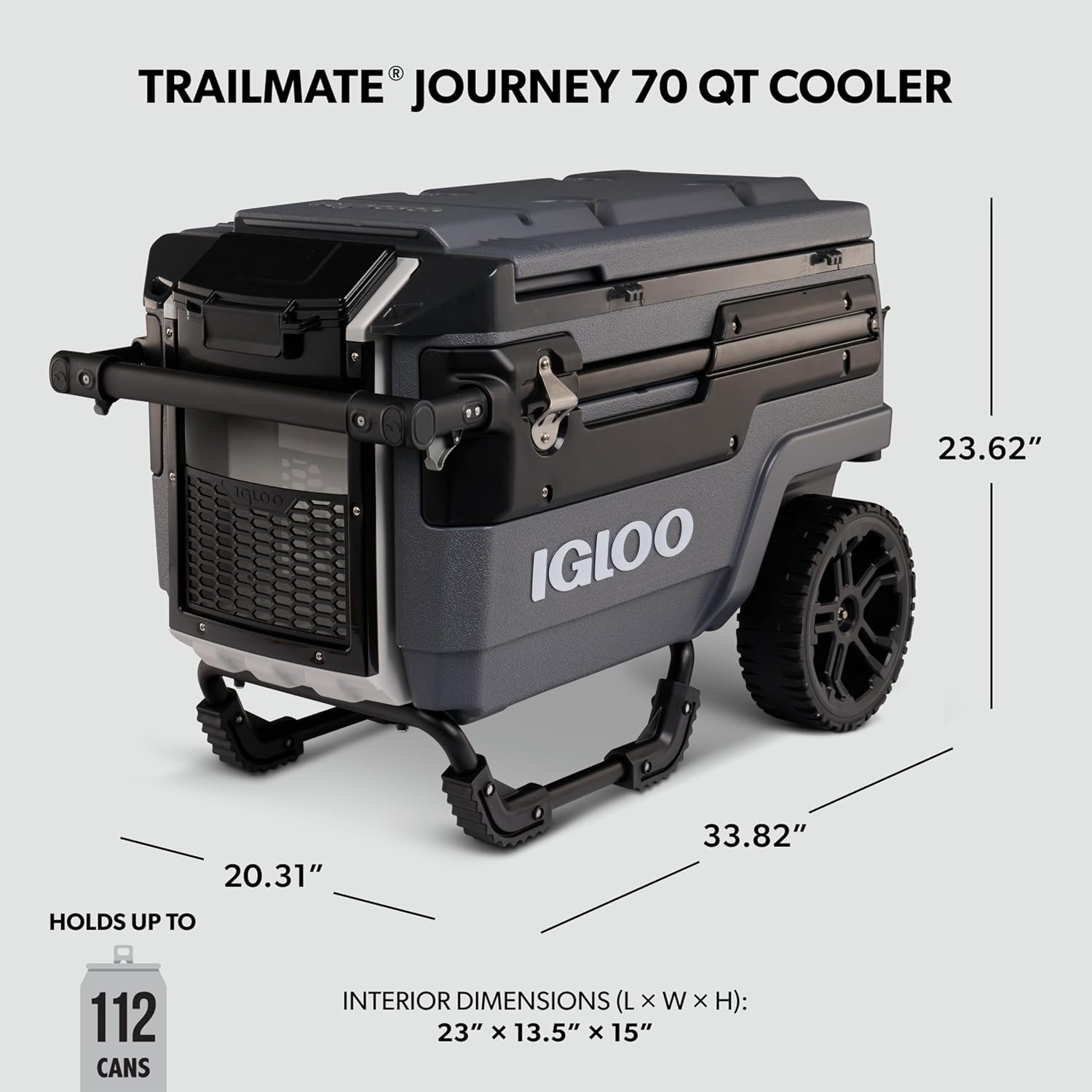
Coolers like the Igloo Trailmate and the Coleman Xtreme Wheeled fall here. The Trailmate is a genuine standout at this level — it uses oversized 7-inch wheels with a wider tread than typical budget models, and owners across aggregated reviews on GearJunkie and REI consistently report it handles gravel paths and packed dirt better than competitors in the same price band. Ice retention is rated at roughly 5 days under ideal conditions (lid closed, pre-chilled, minimal opening), per manufacturer specs — real-world owner reports cluster around 3–4 days in warm weather, which is honest performance for a $100 cooler.
The tradeoffs: the injection-molded body will flex under heavy loads, the latches feel light, and the telescoping handle wobbles when fully extended. For a festival or a car-adjacent campsite where you’re not hauling more than 50 yards, this tier works. For a half-mile carry over mixed terrain, it’s asking a lot.
Mid-tier ($180–$280): The sweet spot for most buyers
This is where the decision gets interesting. The Igloo BMX 72 and the RovR RollR 60 both live here, and they represent genuinely different design philosophies.
The Igloo BMX 72 uses a rotomolded body — unusual at this price — with 8-inch never-flat tires (foam-filled, so no flat risk) on a stainless axle. Manufacturer specs rate it at 9 days ice retention. Consumer Reports’ 2025 cooler ratings put its real-world ice performance in the 6–7 day range for a properly loaded and pre-chilled unit, which tracks with owner forums. The BMX 72 is legitimately heavy empty (about 28 lbs), but the rigidity means the wheel mounts don’t flex under load.
The RovR RollR 60 takes a different approach: it uses a 60-quart capacity with 8-inch pneumatic (air-filled) tires on a proper wheel axle borrowed more from utility cart design than cooler design. Owners consistently report it’s the easiest-rolling wheeled cooler they’ve used on uneven terrain — the pneumatic tires absorb shock in a way that foam-fill tires don’t. GearJunkie’s review notes the trade-off is puncture risk if you’re in cactus country or near construction debris, plus a slightly softer ice retention (rated 10 days by RovR, owner reports cluster around 5–6 days in summer heat, which is still strong).
Premium tier ($350–$500): YETI territory
The YETI Tundra Haul is the reference point here. It uses a rotomolded body, NeverFlat foam-filled wheels rated to 500 lbs load capacity per the axle spec sheet, and YETI’s PermaFrost insulation — rated for 10+ days. Owners in long-run reviews note it handles gravel, grass, and beach sand better than anything else in this tier, with the caveat that it weighs 35 lbs empty and the 55-quart capacity (YETI’s baseline Haul size) fills fast once ice goes in.
The honest case against the Tundra Haul: you’re paying a meaningful premium for brand equity on top of legitimate performance. Consumer Reports’ 2025 ratings show ice retention competitive with the Igloo BMX 72 — the gap narrows considerably once both units are pre-chilled and properly loaded. The YETI wins on build feel, hardware quality, and wheel durability under repeated abuse. Whether that’s worth the $150–$200 delta over the BMX 72 depends entirely on how hard you actually use it.
Prosumer/expedition tier ($500+): Overkill for most, right-sized for some
Grizzly and Kong coolers occupy this space, built for guides, outfitters, and people running multi-day river trips where the cooler gets dragged over boat ramps and strapped into rafts repeatedly. These aren’t primarily wheeled coolers in the traditional sense — most use add-on wheel kits or are designed to pair with wheeled frames. For the campsite-to-tailgate use case this guide is focused on, you’re almost certainly better served by the YETI Tundra Haul unless you’re running commercial trips.
By the Numbers
| Cooler | Wheel Diameter | Ice Rating (Mfr.) | Price (MSRP, 2026) | Wheel Type |
|---|---|---|---|---|
| Igloo Trailmate 70 | 7 in | 5 days | ~$100 | Injection-molded plastic |
| Igloo BMX 72 | 8 in | 9 days | ~$220 | Foam-fill, stainless axle |
| RovR RollR 60 | 8 in | 10 days | ~$260 | Pneumatic (air-fill) |
| YETI Tundra Haul 55 | 8 in | 10+ days | ~$450 | Foam-fill NeverFlat, rated 500 lbs |
Manufacturer ice ratings assume pre-chilled cooler, 2:1 ice-to-contents ratio, lid closed. Real-world performance typically runs 20–40% below rated figures in summer temps — per REI Co-op’s cooler buying guide methodology.
The Terrain Question: What Actually Matters for Your Use Case
Here’s the tradeoff framework worth running before you buy:
Distance of haul. If your standard move is 100 feet or less across a paved lot or hard-pack, the budget tier handles it. If you’re regularly covering 200+ feet of gravel, roots, or grass, wheel diameter and chassis rigidity start mattering in ways the spec sheet can’t fully capture — and owner reports become your best signal.
Load weight. A 60-quart cooler loaded with food and ice can easily hit 80–90 lbs. Axle load ratings matter: the Igloo BMX’s stainless axle and the YETI’s 500-lb rated wheel assembly are built for this. Cheaper plastic axles are not. REI’s cooler guide specifically recommends checking axle material (stainless vs. plastic) before buying any wheeled cooler you plan to load heavily.
Frequency and conditions. If you’re a twice-a-year camper on developed sites, the $220 BMX tier is hard to argue against. If you’re running 15+ trips a year on mixed terrain — overlanding weekends, beach launches, gravel-road campsites — the YETI’s build quality amortizes reasonably over 5–7 years of actual hard use. The cost-per-trip math shifts in its favor around year three for high-frequency users.
Puncture risk. If your terrain includes thorns, gravel shards, or construction debris, pneumatic tires (RovR RollR) are the one real vulnerability to weigh. Foam-fill wheels eliminate that risk entirely, which is why the YETI and BMX spec them — with a modest ride-quality trade-off on rough terrain.
The Decision Rule
If you’re buying for occasional weekend camping and car-side tailgates where the haul is under 100 feet: the Igloo Trailmate or BMX 72 is the honest call. Don’t let premium marketing talk you into spending $450 for a use case a $220 cooler handles well.
If you haul regularly across genuine mixed terrain — gravel, grass, packed dirt — and you load it heavy: the RovR RollR 60 or YETI Tundra Haul. The pneumatic advantage of the RovR is real on rough ground; the YETI wins if puncture risk is a concern or if you’re buying for 5+ years of hard use and want the hardware to outlast the foam.
If you’re in cactus country, near boat ramps with gravel edges, or anywhere debris is a constant: avoid pneumatic tires entirely. The BMX 72 or Tundra Haul’s foam-fill wheels are the right call.
One thing worth noting: wheeled cooler prices tend to follow a predictable seasonal pattern, with the steepest discounts appearing in September–October as retailers clear summer inventory. If your next trip is fall or winter, waiting that window out frequently yields 20–30% off MSRP on YETI and Igloo premium models — worth factoring into the calculus if timing is flexible.