Imagine you just bought a used 2021 Ford Explorer, and a friend texts you a deal on a used kayak. You want to haul both the kayak and your mountain bikes this summer — but you have no idea whether your roof can even hold a rack, let alone which crossbars to buy. That’s where this guide starts.
Roof rack crossbars are the two horizontal bars that run side-to-side across the top of your vehicle. They’re the foundation for mounting bike carriers, kayak saddles, rooftop tents, cargo boxes, and almost any other gear-hauling system. The catch: there is no universal crossbar that fits every SUV. Fit depends on whether your roof has built-in raised rails (the two side tracks you can see from the ground), flush side rails (recessed channels), or a bare naked roof with no rails at all. Get that wrong, and you’re returning parts or — worse — driving with an unsecured load. This guide walks you through what to buy for the most common SUV platforms: Jeep, Toyota, Ford, and a few others worth calling out, with enough supporting math and source-backed context to make a confident call.
| EDITOR'S PICK[Yakima Set of 2 Roof Rack Cross…](https://www.amazon.com/dp/B0171A6FFA?tag=greenflower20-20) | Mid-tier[KINGGERI 300lbs Roof Racks Cros…](https://www.amazon.com/dp/B0DX6W1Y5T?tag=greenflower20-20) | Budget pick[Autekcomma Roof Rack Cross Bars…](https://www.amazon.com/dp/B0CZ8QX9SQ?tag=greenflower20-20) | |
|---|---|---|---|
| Weight capacity | — | 300lbs | — |
| Length | 50" | — | — |
| Anti-theft lock | — | — | ✓ |
| Price | $269.95 | $99.00 | $82.99 |
| See on Amazon → | See on Amazon → | See on Amazon → |
Why Vehicle-Specific Fit Is Everything
The single biggest mistake buyers make is treating crossbars like a generic accessory. Per the REI Co-op Roof Rack Buying Guide, there are four roof configurations that determine which mounting foot/tower system will work:
- Raised side rails — two rails sitting visibly above the roof surface (common on Toyota 4Runner, Jeep Cherokee, Subaru Outback)
- Flush side rails — rails that sit flush or recessed into the roofline (common on Toyota RAV4, Ford Escape)
- Fixed mounting points — factory-installed anchor points with caps that pop off (common on many European SUVs, and some Ford models)
- Bare roof / no rails — smooth metal with no rails or anchor points (common on Ford Explorer with base trims, some Honda CR-Vs)
Each roof type requires a specific tower or foot style. The bar itself (the crossbar spanning the two towers) is often interchangeable between brands once you have the right feet — but the feet and the fit kit are vehicle-specific. Both Thule and Yakima publish vehicle compatibility databases (Thule calls theirs “Fit My Car”; Yakima’s is labeled the “Vehicle Fit Guide”) where you enter year, make, model, and trim to get an exact list of compatible kits.
By the Numbers
| Configuration | Typical Fit Kit Cost | Compatible Bar Options | Example Vehicles |
|---|---|---|---|
| Raised rails | $80–$140 | Most universal bars | 4Runner, Jeep Grand Cherokee (older), Outback |
| Flush rails | $90–$160 | Brand-specific towers | RAV4, Ford Edge, Kia Telluride |
| Fixed points | $100–$180 | Brand-specific adapters | Ford Explorer (Sport trim+), VW Tiguan |
| Bare roof | $130–$220 | Clamp-style towers only | Honda CR-V, some Pathfinder trims |
Prices reflect May 2026 retail; the towers/feet portion typically runs $80–$120, and a pair of mid-grade aluminum crossbars adds another $60–$100.
Jeep: Grand Cherokee, Wrangler, and Cherokee
Jeep’s lineup spans dramatically different roof situations, so don’t assume one Jeep answer applies to another.
Wrangler (JL and JK): The Wrangler is a favorite starting point for overlanders and it has one of the cleanest rack ecosystems in the market. The JL and JK Wrangler hardtop doesn’t use a traditional crossbar system — most owners go with Wrangler-specific rack platforms from brands like Smittybilt, Gobi, or the Mopar factory rack that bolts directly to factory hard-top mounting points. If you want a crossbar-only setup (lighter, more aerodynamic), Thule’s AeroBlade Edge with a Wrangler-specific fit kit is a popular, well-reviewed option. Owners in long-run forum discussions consistently report that the fit kit matters enormously here — a sloppy fit on a Wrangler running dirt roads will produce noise and micro-movement that wears the roof finish over time.
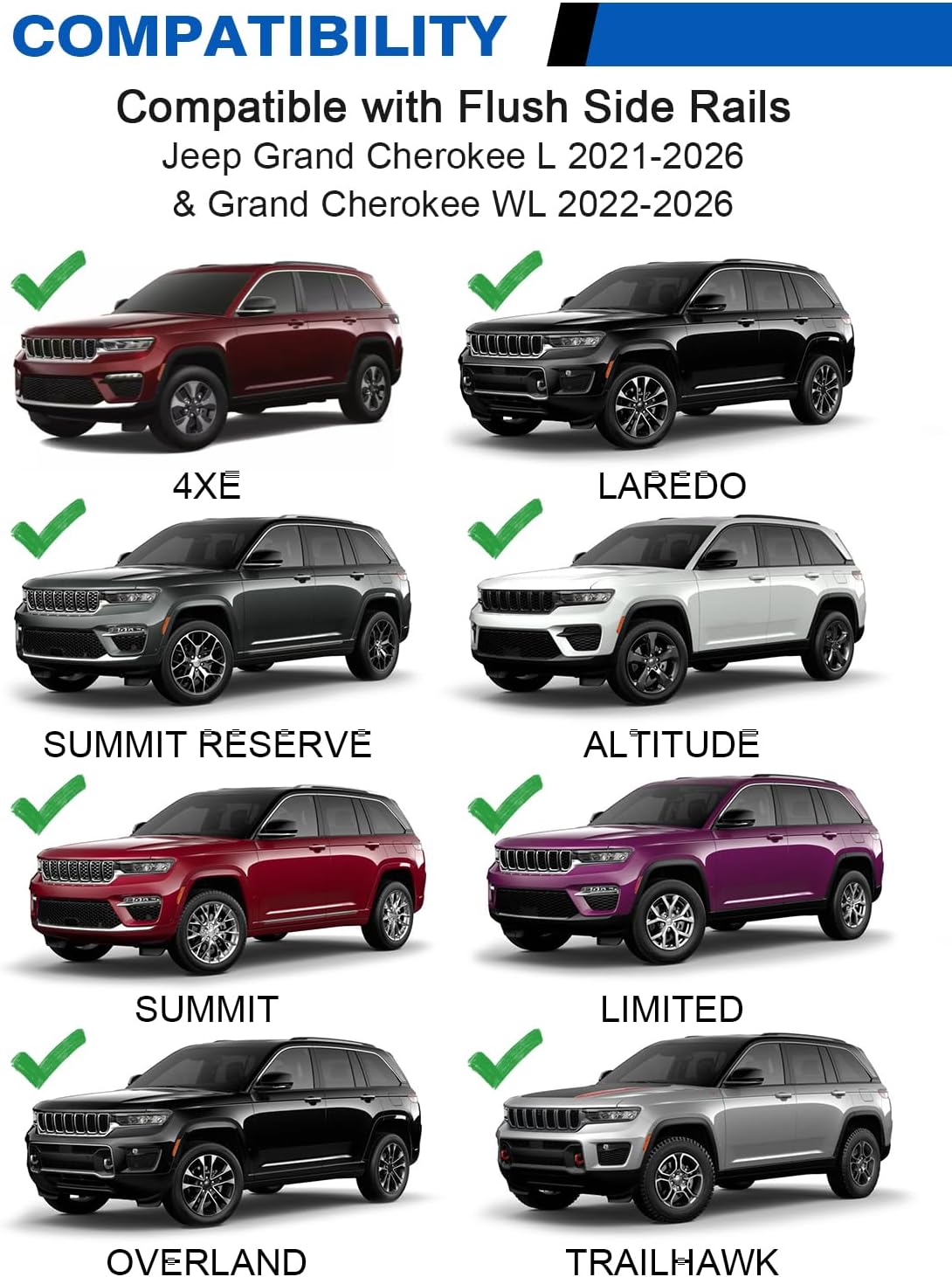
Grand Cherokee (WL, 2022–present): The current-gen Grand Cherokee has flush side rails on most trims. Thule’s Evo Flush Rail foot with an AeroBlade or WingBar crossbar is the most cited setup in aggregated owner reviews; Yakima’s FlushBar system is a direct competitor. Wirecutter’s Best Roof Rack review calls out Thule’s AeroBlade Edge as a top pick for flush-rail SUVs, noting its low wind noise profile and 165-lb dynamic load rating (manufacturer-rated). That 165-lb figure covers most two-bike setups plus a cargo box comfortably.
Jeep Cherokee (KL): The Cherokee typically ships with raised side rails, making it one of the easier fits. A set of raised-rail feet from Thule or Yakima snaps on without drilling. If you’re running a kayak setup, the extra height from raised rails actually gives you a little more clearance for saddles, which owners hauling sit-on-top kayaks appreciate.
Toyota: 4Runner, RAV4, and Tacoma
Toyota has one of the broadest and most loyal roof rack communities, in part because its vehicles tend to age well and stay in service for overlanding long after the warranty expires.
4Runner (5th gen, 2010–present): This is arguably the most rack-friendly SUV on the market. The 5th-gen 4Runner ships with factory raised side rails on almost every trim. You can run Thule or Yakima raised-rail feet, or go straight to an aftermarket roof rack platform — Prinsu Design Studio, Sherpa Equipment Co., and Front Runner all make bolt-on slimline rack platforms for the 5th gen that replace crossbars entirely and give you a full cargo platform. For crossbars specifically, Yakima’s JetStream bar with raised-rail towers is consistently praised for rigidity; Gear Junkie’s roof rack roundup named it among the quietest options at highway speeds.
RAV4 (5th gen, 2019–present): The RAV4 has flush side rails and is one of the highest-volume vehicles in the US market, so compatibility kits are abundant and well-developed. Thule’s Evo Flush Rail with WingBar Evo crossbars is the most commonly recommended pairing, manufacturer-rated to 165 lbs dynamic. One tradeoff worth naming: the RAV4’s sloped rear roofline shortens the usable span between bars, which can be a constraint when mounting longer kayak saddles or a full-size rooftop tent. If you’re planning a tent, measure your tent’s footprint against the 4Runner or a body-on-frame alternative before committing.
Tacoma (3rd gen, 2016–present): The Tacoma has a bed, not an SUV roofline, but truck camper shell owners frequently ask about cab-over crossbar options. For the cab roof only, Yakima’s JetStream with Tracks mounting system (which uses factory-drilled mounting holes under cap strips) is a documented fit. If you’re building out a full bed rack for the bed, that’s a different product category entirely — companies like Leitner Designs and Rhino-Rack make bed systems that don’t interact with roof crossbars at all.
Ford: Explorer, Bronco Sport, and Escape
Ford’s lineup in 2026 covers everything from recreational-family SUVs to trail-focused rigs, and roof configurations vary more than you’d expect across trims of the same model.
Explorer (7th gen platform): This is where trim-level differences really bite buyers. Base and mid trims often ship with fixed mounting points under caps; higher Sport and ST trims frequently have flush rails. Before ordering anything, pull the window sticker or check the build data on your VIN — Thule’s Fit My Car database handles this well. Wirecutter’s rack review specifically flags the Explorer as a vehicle where trim verification is a must before purchase. For fixed-point configurations, Thule’s 7105 FixPoint foot kit is the standard recommendation; it snaps into the factory anchor points without any drilling.
Bronco Sport: The Bronco Sport has factory rails on all but the base trim and is genuinely well-suited for crossbar setups. Owners report that the factory Yakima JetStream bar (an OEM partnership on some trims) integrates cleanly. For aftermarket, Yakima’s TimberLine towers with flush-rail compatibility are frequently cited by Bronco Sport owners who want a modular setup they can expand with a bike carrier or basket later.
Escape (4th gen, 2020–present): Flush side rails, thin roofline, and a load rating that owners sometimes underestimate. Ford rates the Escape roof at 150 lbs static — but crossbar systems carry a dynamic (in-motion) rating, which is typically lower. Thule and Yakima’s Escape-specific kits are both rated around 165 lbs dynamic, but that number already accounts for the vehicle’s roof limits. If you’re planning to run a rooftop tent on an Escape, most tent manufacturers (iKamper, Roofnest) explicitly flag that tents in the 120–150-lb range are at the limit for this vehicle class, and the tent’s static sleep load adds to that figure. It’s worth being honest here: smaller crossover SUVs aren’t the best rooftop-tent platforms, and an Escape with a 150-lb roof rating is not where you want to be experimenting.
The Brands Worth Knowing: Thule, Yakima, and the Field
At the $100–$300 total crossbar system price point, Thule and Yakima are the dominant, most-reviewed brands with the broadest vehicle fit libraries. Outside Online’s 2025 roof rack review named Thule’s AeroBlade Edge system its top overall pick for aerodynamic performance and fit-kit coverage. Gear Junkie consistently rates Yakima’s JetStream bar for its rigidity-to-weight ratio and lower noise profile on highway speeds.
Rhino-Rack is worth knowing for overlanding builds — they have a strong presence in the Tacoma and 4Runner communities and offer base platforms that integrate with their Pioneer tray system. Malone offers budget-friendly crossbars in the $80–$140 range that owners of car-top kayaks frequently use, though the fit-kit library is narrower. Kuat has grown from a bike-rack brand into full crossbar systems and is well-regarded in the mountain bike community.
One category the big brands don’t always cover well: if you’re on a Jeep Wrangler, Toyota Land Cruiser 300-series, or a heavily lifted 4Runner, the dedicated overlanding rack manufacturers (Front Runner, Smittybilt Overlander, Gobi) often offer better integration than standard crossbar kits because they bolt to factory hard points and carry heavier dynamic ratings.
The Decision Rule
If you leave with one framework, make it this:
- You have raised side rails → pick any reputable brand’s raised-rail tower + aluminum bar. Thule and Yakima both cover this cheaply and well. Budget $130–$200 for a solid setup.
- You have flush rails or fixed points → go vehicle-specific. Run your year/make/model/trim through Thule’s Fit My Car or Yakima’s Vehicle Fit Guide before touching a checkout button. Budget $180–$280.
- You have a bare roof → you’ll need clamp-style towers, and the total cost climbs. Budget $200–$320, and verify your roof’s load rating in the owner’s manual before ordering a rooftop tent.
- You’re overlanding a Wrangler, 4Runner, or Land Cruiser → skip the crossbar conversation and look at full rack platforms from Front Runner, Gobi, or Smittybilt. The crossbar system is the budget entry point; a platform rack is the upgrade that makes long-haul gear management actually functional.
The fit-kit database is the most important tool in this purchase. Use it before you buy, and cross-reference load ratings against the heaviest thing you’ll ever put on that roof — not your average load, but your heaviest day. That’s the number that protects both your gear and the roof that carries it.