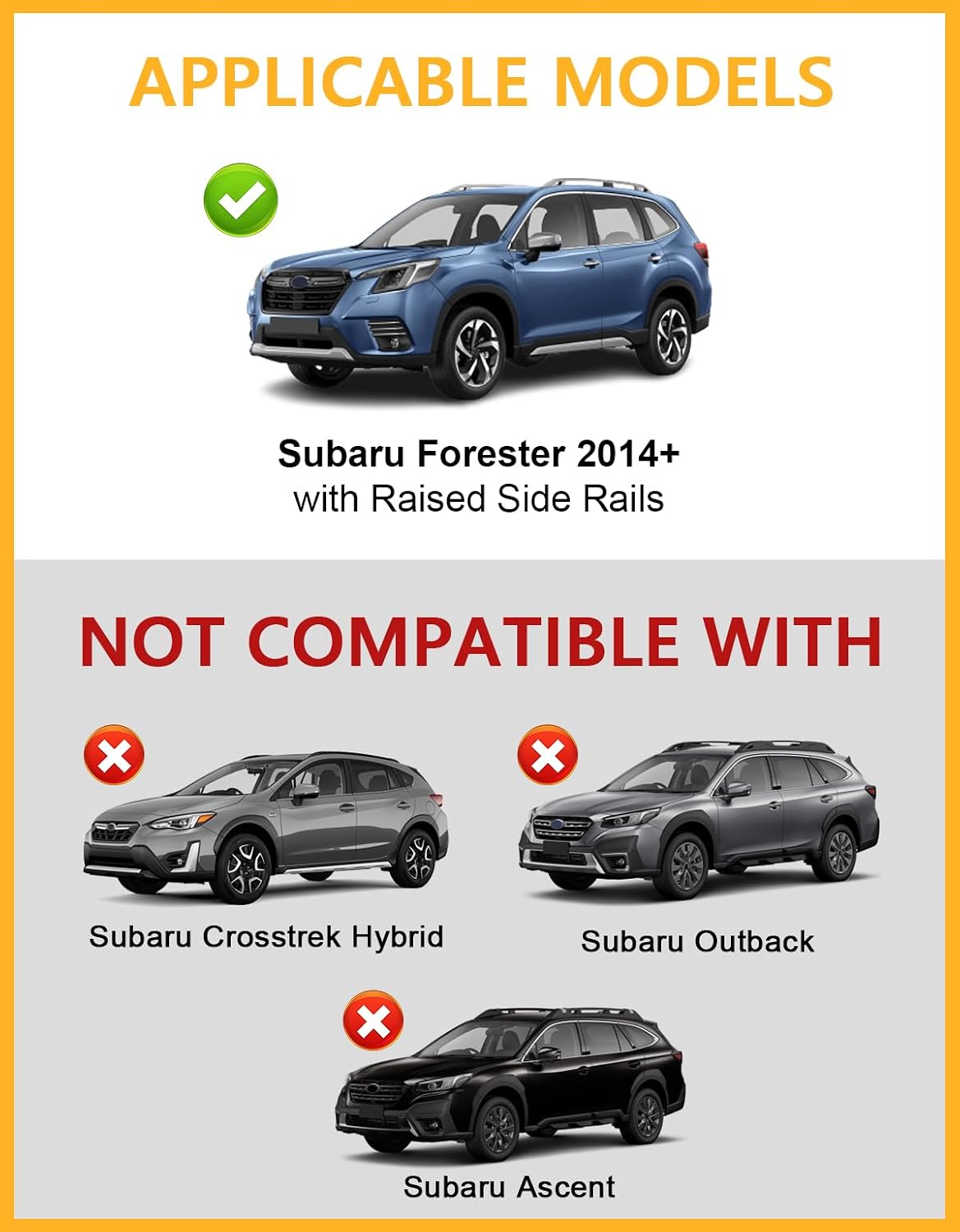
Picture this: you’ve just loaded a pair of kayaks onto your friend’s Subaru Outback using their slick factory crossbars, and now you’re back home staring at your Forester’s roof wondering why your bolt-on solution looks nothing like theirs — and whether it’ll actually hold on the highway at 75 mph. Crossbars are the horizontal bars that span your roof from side to side, forming the foundation that everything else — kayak carriers, ski mounts, roof boxes, bike trays — clips or straps onto. Get the right ones and they’re invisible infrastructure. Get the wrong ones and you’re either staring at mounting hardware that won’t fit, or worse, operating over your vehicle’s rated load limit. This guide walks through Subaru Forester compatibility year by year, decodes the load numbers that actually matter, and gives you a clear decision path whether you’re hauling a single rooftop cargo box to a ski resort or stacking a full overlanding kit for a week in the backcountry.
| EDITOR'S PICK[Tuyoung 330lbs Heavy Duty Roof…](https://www.amazon.com/dp/B0CP7HBKB9?tag=greenflower20-20) | Mid-tier[Tuyoung 300lbs Roof Rack Cross…](https://www.amazon.com/dp/B0D12MDLS1?tag=greenflower20-20) | Budget pick[Amazon Basics Cross Rail Roof R…](https://www.amazon.com/dp/B083T53K3P?tag=greenflower20-20) | |
|---|---|---|---|
| Weight Capacity | 330 lbs | 300 lbs | — |
| Material | All Aluminum | Aluminum Metal | — |
| Lockable | ✓ | ✓ | — |
| Compatible Years | 2014-2026 | 2014-2026 | — |
| Price | $99.99 | $79.99 | $55.91 |
| See on Amazon → | See on Amazon → | See on Amazon → |
Why Forester Crossbar Compatibility Is More Complicated Than It Looks
The Subaru Forester has gone through five distinct generations since 1997, and within each generation there are meaningful structural differences that affect which crossbar systems mount correctly. The confusion intensifies because Subaru has used two different roof designs across those generations: raised side rails (the longitudinal bars that run front-to-back along the roofline, standard on most trims) and bare roofs with pre-drilled flush mount points (found on some base trim levels and earlier models).
These two roof types require fundamentally different mounting hardware. Raised-rail systems clamp onto the existing factory rails without drilling. Bare-roof systems use door-frame clamps or factory-designated mounting points and typically require fit-kit legs specific to the vehicle. Misidentifying your roof type is the single most common reason a crossbar kit arrives and doesn’t install.
Here’s where it gets more nuanced for Forester buyers: the current-generation Forester (2019–present, SK platform) ships with factory raised rails standard across nearly all trims, making crossbar selection relatively straightforward. But fourth-generation Foresters (2014–2018, SJ platform) had some base trims that omitted factory rails, and third-generation models (2009–2013) require extra attention to tower foot compatibility because the rail profile changed between the 2009–2011 and 2012–2013 model years.
The Thule Group’s Roof Rack Fit Guide and Yakima’s “Fit My Car” compatibility database both flag year-specific leg/foot differences within the SJ generation — a detail that gets glossed over in many generic reviews. If you’re working from a used Forester purchase and aren’t sure which trim you have, check the sticker inside the driver’s door jamb for the full model code before ordering.
Generation-by-Generation Compatibility Breakdown
Fifth Generation (2019–2024, SK Platform)
This is the sweet spot for crossbar buyers. According to the Subaru of America owner’s manual for 2019–2024 Forester models, the factory-installed raised rails are structurally reinforced and rated to accept aftermarket crossbar systems. Both Thule and Yakima offer dedicated fit kits for the SK platform — Thule’s WingBar Evo and Yakima’s StreamLine series each have SK-specific tower feet that lock directly onto the raised rails with no modification.
Maximum roof load rating (SK Forester): Subaru rates the roof at 176 lbs (80 kg) static when the vehicle is not moving, but critically, the dynamic load limit — meaning the weight limit while driving — drops to 165 lbs (75 kg) for the vehicle roof itself. This is the number that actually governs crossbar selection and what you put on top.
What matters more than most buyers realize: crossbar manufacturers publish their own dynamic ratings, and those ratings must be at or below the vehicle’s dynamic limit. A crossbar system rated at 165 lbs on a roof with a 165-lb dynamic limit gives you zero margin for the weight of the bars themselves (typically 5–8 lbs per pair) plus mounting hardware. Practically speaking, plan your load at 140–150 lbs maximum to stay comfortable and legal.
Fourth Generation (2014–2018, SJ Platform)
The SJ generation is where most compatibility headaches originate. Sport, Premium, Limited, and Touring trims came with raised side rails from the factory. The base 2.5i trim in the 2014 and 2015 model years occasionally shipped without rails, depending on the regional package. Yakima’s compatibility database specifically distinguishes between “with rails” and “without rails” configurations for 2014–2018 entries.
For SJ models with raised rails, both Thule’s SmartSlide and Yakima’s JetStream crossbar systems offer direct-fit solutions. For bare-roof SJ Foresters, you’re looking at door-jamb clamp systems — Thule’s Hull-a-Port or comparable clamping towers with a specific SJ fit kit. These work, but the installation is more involved and the load rating typically drops to around 150 lbs dynamic due to how the load paths transfer through the door frame rather than reinforced rail mounts.
Between 2012–2013 and 2009–2011 (third generation): the rail geometry changed enough that tower feet are not interchangeable. The Thule Roof Rack Fit Guide explicitly lists different fit-kit part numbers for pre-2012 and post-2012 third-gen Foresters. If you’re buying used crossbars from a forum, confirm the exact model year before assuming a 2011 fit kit works on your 2013.
Load Ratings: The Numbers That Actually Govern Your Decisions
Crossbar specs come with two load figures, and conflating them is a genuine safety risk:
By the numbers:
- Subaru Forester (SK, 2019–2024) static roof load: 176 lbs
- Subaru Forester (SK, 2019–2024) dynamic roof load: 165 lbs
- Thule WingBar Evo 127 cm pair: rated to 165 lbs dynamic (system weight ~7 lbs)
- Yakima StreamLine CrossBar 50” pair: rated to 165 lbs dynamic (system weight ~6.5 lbs)
The math that matters: 165 lbs (vehicle limit) minus ~7 lbs (bar weight) minus mounting hardware (~2 lbs) = ~156 lbs of actual cargo capacity. If you’re running a rooftop tent — which typically weighs 130–160 lbs — you’re at or over limit before you add sleeping gear. Rooftop tent manufacturers are required to publish both tent weight and occupant load separately; the combined figure routinely exceeds what a factory rail crossbar system can safely handle dynamically. For rooftop tent setups, a dedicated Forester-specific rack platform that spreads load across more mounting points (Rhino-Rack’s Backbone system or a similar load-distribution platform) is the correct answer, not a standard two-bar crossbar kit.
Per the REI Co-op Roof Rack Buying Guide, the most common buyer mistake is confusing a crossbar’s static rating (what it holds while parked) with its dynamic rating (highway speeds, wind loading, cornering forces). Static ratings can be 2–3x higher than dynamic ratings. Always design your load around the dynamic number.
Gear Junkie’s coverage of roof rack systems reinforces this: reviewers consistently note that crossbar deflection under wind load increases meaningfully above 65 mph, which is why many manufacturers spec their dynamic ratings at 65 mph and recommend reducing load by 10–15% for sustained highway speeds above 75 mph.
Head-to-Head: Thule WingBar Evo vs. Yakima StreamLine for the Forester
Both systems are purpose-designed for raised-rail Foresters and are the most commonly referenced options in owner communities. Here’s the honest tradeoff picture based on published specs and consistent owner-reported feedback:
Thule WingBar Evo (SK Forester fit):
- Aerodynamic blade profile reduces wind noise significantly — owners on Forester-specific forums consistently cite this as the standout functional advantage over flat-bar alternatives
- SmartSlide foot system allows stepless positioning along the rail, which matters when you’re balancing asymmetric loads or using a side-loading kayak carrier
- Published dynamic rating: 165 lbs
- Bar length options: 118 cm and 127 cm — the 127 cm gives more usable spread for wider cargo like a canoe or extended rooftop box
- Price point (2026): approximately $280–$320 per complete pair with Forester-specific fit kit
Yakima StreamLine CrossBar (SK Forester fit):
- T-slot channel runs the full bar length, making accessory positioning faster if you’re swapping between bike trays, ski mounts, and cargo boxes seasonally
- Marginally lower profile than the WingBar Evo, which some owners prefer aesthetically on lower-trim Foresters
- Published dynamic rating: 165 lbs
- Available in 48”, 50”, and 58” lengths — the 50” is the standard recommendation for Foresters; the 58” is designed for full-size trucks and adds unnecessary overhang
- Price point (2026): approximately $240–$290 per complete pair with fit kit
The tradeoff in plain terms: if wind noise on long highway drives matters to you — and it compounds across a 6-hour trip to a trailhead — Thule’s blade profile has a meaningful functional edge, and owners consistently report it. If you’re swapping accessories frequently across seasons, Yakima’s full-length T-slot is genuinely faster to work with. At matched load ratings, neither has a structural advantage over the other for the SK Forester application.
Pre-Buy Checklist: What to Confirm Before You Order
Owners and forum communities — particularly the active Forester-specific threads on dedicated Subaru owner sites — have identified a consistent set of order errors that result in returns. Run through these before clicking purchase:
- Confirm your roof type (raised rails vs. bare roof) — don’t assume based on trim name alone; verify visually
- Confirm your exact model year — third and fourth-gen Foresters have intra-generation fit-kit differences
- Note whether you have a moonroof/sunroof — some panoramic roof packages on SJ and SK Foresters move the rail mounting positions, changing which bar length is appropriate
- Calculate your actual load — bar weight + hardware + cargo + any dynamic margin, all against the vehicle’s 165 lb dynamic limit
- Check your intended accessory mounting system — confirm the crossbar’s channel profile (T-slot, round bar, or square bar) is compatible with the specific carrier or box you’re pairing it with
The Decision Rule
If you own a 2019–2024 SK Forester with factory raised rails and your use case is ski boxes, bike trays, or standard cargo carriers under 150 lbs: either the Thule WingBar Evo (127 cm) or the Yakima StreamLine (50”) will serve you correctly — choose based on wind-noise sensitivity (Thule) versus accessory-swap frequency (Yakima).
If you own a 2014–2018 SJ Forester, verify your trim before ordering, and match the fit kit number explicitly to your rail configuration using Thule’s or Yakima’s online fit guides, not a generic “Forester” search.
If you’re planning a rooftop tent or any load over 140 lbs, a standard two-bar crossbar system is the wrong starting point. A load-distribution platform designed for the Forester’s specific roof structure is the correct answer, and that’s a separate guide.
The bars are infrastructure. Get the compatibility right first, then spec the accessories.