Picture this: you’ve been renting paddleboards on weekend lake trips for two seasons, and you’re finally ready to own one. You want something you can throw in the back of your car — not strap to a roof rack — and take to a different body of water every weekend. An inflatable SUP (stand-up paddleboard) sounds like the obvious answer. But then you start reading spec sheets and review threads, and suddenly you’re drowning in numbers: PSI ratings, drop-stitch density, rocker profiles, fin configurations. Some boards cost $400. Others cost $1,800. And nearly every brand claims its board is “rigid as a hard board.”
This guide cuts through that noise. We’ll explain what the specs actually predict about on-water performance, which numbers matter for intermediate paddlers (people who’ve logged real time on the water and want to improve, not just float), and where the spec sheet goes completely silent. By the end, you’ll have a clear decision framework — not just a ranked list.
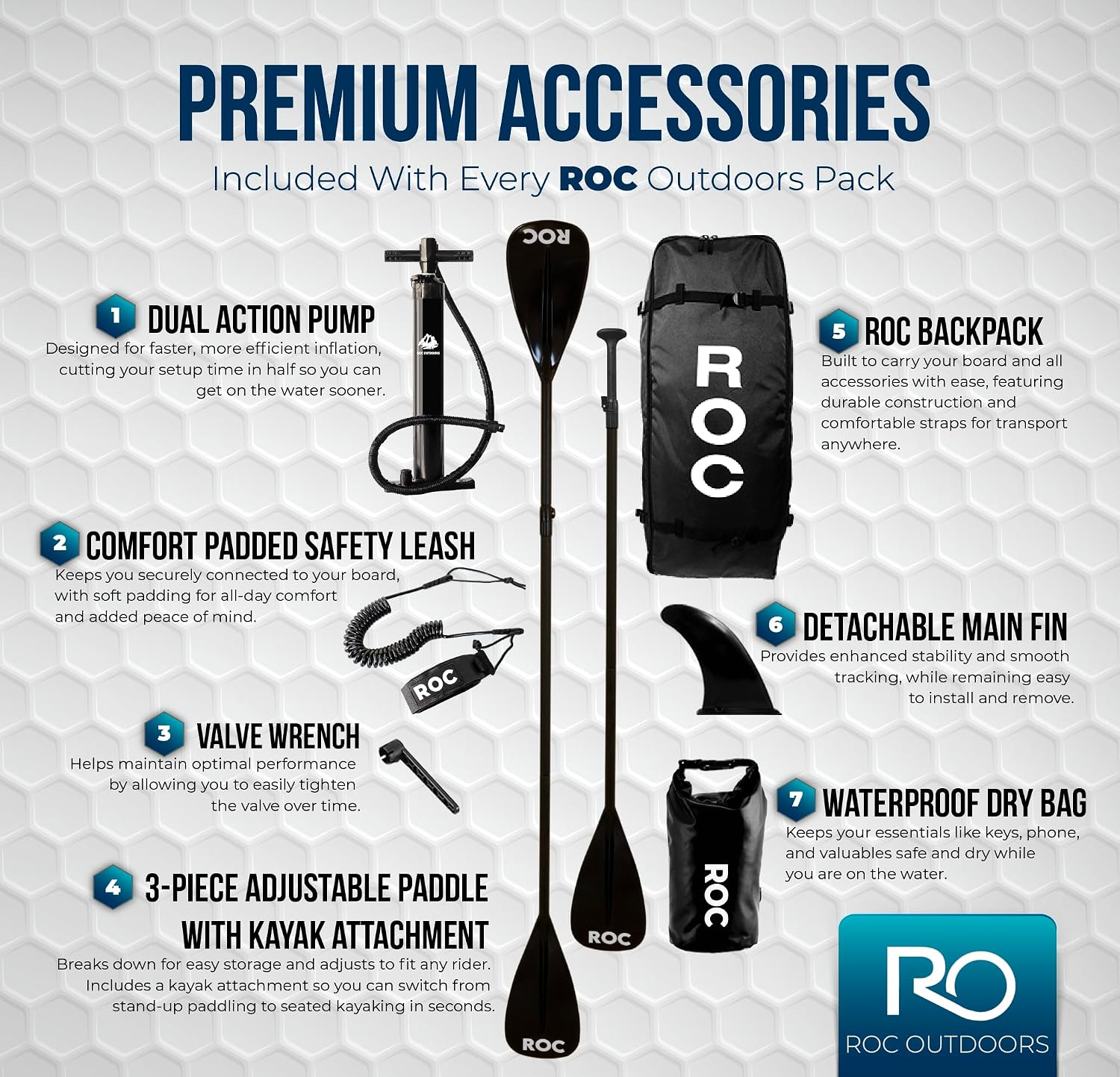
| EDITOR'S PICKSkatinger 11'6×35" Super Wide I… | Mid-tier[Roc Inflatable Stand Up Paddle…](https://www.amazon.com/dp/B0GWHSBFVQ?tag=greenflower20-20) | Budget pickFBSPORT 11' Premium Stand Up Pa… | |
|---|---|---|---|
| Length | 11'6" | 10'6" | 11' |
| Width | 35" | — | — |
| Weight Cap. | 450lb | — | — |
| Bag Included | ✓ | — | ✓ |
| Leash Included | — | — | ✓ |
| Price | $279.99 | $199.99 | $149.99 |
| See on Amazon → | See on Amazon → | See on Amazon → |
What “Stiffness” Actually Means — and Why It’s the Whole Game
When manufacturers say an inflatable SUP is “stiff,” they’re describing how much the board flexes lengthwise under load — meaning under your weight, especially when you shift toward the center while paddling. A board that sags noticeably in the middle is slower (the hull shape deforms, creating drag), less responsive to paddle strokes, and harder to balance on than a board that stays flat.
Three things drive stiffness in an inflatable:
1. Construction method. The industry standard for performance boards is dual-layer or fusion laminate construction, where two layers of PVC are bonded with a woven drop-stitch core (thousands of threads connecting top and bottom layers). Single-layer boards — common under $500 — use the same drop-stitch core but only one PVC shell. Per Paddling Magazine’s inflatable SUP buyers guide, the difference shows up most noticeably in boards longer than 10’6”: single-layer boards at that length will flex measurably under riders above 170 pounds, while dual-layer or fusion boards in the same size hold their shape significantly better at the same pressure.
2. Max inflation pressure (PSI). Most recreational iSUPs are rated to 15 PSI. Stiffer performance boards are rated to 18–25 PSI. Higher PSI alone doesn’t make a board stiff — construction quality determines whether the board can hold that pressure safely and translate it into rigidity. REI’s “How to Choose a Stand-Up Paddleboard” guide notes that many paddlers underinflate their boards (stopping at 10–12 PSI when the board is rated to 15 or higher), which is one of the most common causes of that “noodly” feeling people associate with inflatables as a category.
3. Board thickness. Most boards are 4 or 6 inches thick. The jump from 4” to 6” substantially increases rigidity — same principle as a thicker beam spanning the same gap. Nearly every performance-tier iSUP on the market today is 6” thick. If you see a board at 4”, treat it as a red flag for intermediate or heavier riders.
The Number That Summarizes This
| Construction Tier | Typical PSI Rating | Flex Under 180 lbs | Price Range (2026) |
|---|---|---|---|
| Single-layer, 4” | 10–15 PSI | Noticeable | $300–$500 |
| Single-layer, 6” | 12–15 PSI | Moderate | $450–$700 |
| Dual-layer / fusion, 6” | 15–25 PSI | Minimal | $700–$1,400 |
| Carbon-rail or woven composite | 18–25 PSI | Near-rigid | $1,400–$2,000+ |
Stability: Width vs. Volume vs. Body Position (and What the Spec Sheet Misses)
Width is the most commonly cited stability metric — and the most oversimplified. A 32” wide board is more stable than a 28” wide board at the same length, all else equal. But “all else equal” is doing a lot of work in that sentence.
Volume placement matters more than raw volume. Boards with fuller noses and tails (more volume distributed toward the ends) feel more stable underfoot than boards with the same total volume concentrated in the center. This is why some narrower touring boards don’t feel as tippy as their width suggests — the volume is spread, and the rail edge catches water more gradually. Gear Junkie’s roundup of 2025 inflatable SUPs noted this consistently: narrower all-around boards from Red Paddle Co and iRocker that emphasize rail design felt more forgiving to intermediate testers than their widths implied.
Rocker affects perceived stability in moving water. Rocker is the upward curve of the board from tail to nose when viewed from the side. More rocker (a more banana-shaped profile) helps the nose ride over waves and chop rather than plowing through them — it’s better for surf or river use. Less rocker (flatter profile) is faster and more stable on flatwater. Most all-around iSUPs split the difference with 3–5 cm of rocker. The spec sheet usually lists this number; not many buyers pay attention to it.
What the spec sheet can’t tell you: the feel of secondary stability — that moment when you shift your weight laterally and the board catches itself rather than dumping you. Secondary stability is a function of rail shape, hull volume distribution, and how the board responds to water pressure, none of which translate neatly to a spec number. Across aggregated owner reviews on REI and Gear Junkie, boards from Red Paddle Co (particularly the Ride series), BOTE’s RACKHAM, and iRocker’s Cruiser consistently earn praise for that “catches itself” quality. Budget boards in the $400–$550 range more often described as “stable until you shift weight, then abrupt.”
Fin Setup: The Spec That Actually Changes How the Board Behaves
Most buyers skim the fin section. Experienced paddlers know it’s where a lot of real-world performance lives.
Single fin (center box only): Better for flatwater and touring. Tracks straighter with less drag. You lose some maneuverability, which matters less on a lake, more in surf or river conditions. The center fin is usually removable and replaceable with aftermarket options — a genuine advantage over fixed-fin arrangements.
Thruster (2+1 or 3-fin): The two side bites add pivot and maneuverability. Better for surf and mixed conditions. Slightly more drag in a straight line, which is a real tradeoff if you’re covering distance or racing.
US Box vs. proprietary fin systems: This is where budget brands create long-term pain. Proprietary fin systems mean you’re locked into replacement fins from one manufacturer. US Box (also called US fin box) is the industry-standard format — replacement fins are available from dozens of makers at $15–$80, and better fins genuinely change the way a board tracks and surfs. Per Outside Online’s roundup of inflatable SUPs, this is one of the details that separates boards worth $800+ from lookalike boards at $400 even when the dimensions are nearly identical.
Weight Limits, Weight Ranges, and What Manufacturers Don’t Advertise
Every iSUP lists a maximum weight capacity. On a 10’6” x 32” all-around board, you’ll commonly see limits of 275–350 pounds. These numbers are not performance targets — they’re structural safety limits. The board won’t sink or burst at 340 pounds. But it will paddle like a loaded barge.
A more honest metric is optimal paddling weight — the range in which the board maintains its designed waterline and hull shape. Most manufacturers don’t publish this. Paddling Magazine’s buyer guide suggests a practical rule: subtract 60–80 pounds from the stated weight limit to find the upper end of the board’s performance range for an average-build paddler. A board rated to 325 pounds performs well for riders up to roughly 250 pounds; beyond that, you’ll notice the nose sitting low and the board feeling sluggish even at full inflation.
This matters especially for intermediate paddlers trying to improve their technique — a board that sits too low in the water punishes your stroke efficiency, making it harder to build good habits.
The Brands Worth Knowing at Each Tier
This isn’t an exhaustive ranking, but based on consistent consensus across Wirecutter’s iSUP review, Gear Junkie’s 2025 roundup, and owner feedback aggregated on REI product pages, a few names emerge reliably at each tier:
$600–$900 range: iRocker’s CRUISER 10’6” and Atoll’s 11’ board are frequently cited as overperformers for their price. Both use dual-layer construction, US Box fins, and hit 15 PSI reliably. iRocker’s package typically includes a good dual-chamber pump and a travel bag that doesn’t feel like an afterthought.
$900–$1,400 range: Red Paddle Co’s RIDE 10’8” is the board most often described as “the one that changed my mind about inflatables” in aggregated owner reviews. The MSL fusion laminate construction and 25 PSI rating produce rigidity that reviewers consistently describe as genuinely close to a hard board for recreational flatwater use. The Ride is also the most commonly recommended board for intermediate paddlers who want to work on stroke technique rather than just floating.
$1,400–$2,000+ range: BOTE’s RACKHAM Aero and Starboard’s TOURING Zen (woven composite construction) serve paddlers who want near-rigid performance and are committed to the sport long-term. At this tier, you’re buying a board you’ll likely paddle for five or more seasons.
If X, Then Y: Your Decision Rule
If you’re under 180 lbs, paddling flatwater 1–2 times a week, and want the best value: the iRocker CRUISER or Atoll 11’ at the $699–$799 price point (as of mid-2026) is the spend-wisely pick. Dual-layer, US Box fins, solid packages.
If you’re over 180 lbs, paddling more than twice a week, or actively working on technique: go directly to Red Paddle Co’s RIDE series. The construction quality difference is real, and owners report significantly less frustration at higher skill levels.
If you’re touring, racing, or doing multi-day paddle trips: skip the all-around category entirely. Look at dedicated touring shapes (narrower, 11’6” or longer) from Red Paddle Co, Starboard, or BOTE. The performance gap between an all-around and a touring-specific board at this use level is larger than any construction-tier difference within the all-around category.
If you’re still deciding between inflatable and hard board: Wirecutter’s iSUP review puts it plainly — a quality dual-layer inflatable above $800 paddles better than a low-end hard board below $700. The tradeoff is the setup time (5–10 minutes to inflate) and the very slight performance ceiling versus a premium hard board. For most intermediate paddlers with storage and transport constraints, the inflatable wins.
One honest caveat: fin feel, secondary stability, and the subtle confidence a board gives you in mixed conditions are genuinely hard to evaluate from specs alone. If you can demo before buying — REI’s demo events, local paddle shops, or rental programs from brands like BOTE — the hour on water will tell you more than any spec sheet can.