Picture this: you’ve driven three hours to a lake-access campsite, set up the tent, got the fire going, and now — finally — it’s time to just sit. Not perch on a cooler. Not crouch on a log. Actually sit, feet off the ground, back supported, rocking gently while the sun drops. That experience is exactly what GCI Outdoor built its lineup of folding rocking chairs around. GCI Outdoor is a Georgia-based gear brand that’s become something of a campsite institution for one specific reason: they figured out how to put a real rocking motion — the kind you’d get from a porch chair — into a foldable, packable frame that fits in the back of an SUV.
If you’re new to the category, a “portable rocking chair” sounds almost contradictory. Traditional rockers have curved wooden bases that make them immovable. GCI solves this with a patented mechanism called Spring Action Rocking Technology — essentially a spring-loaded base that lets the chair rock back and forth without needing curved rails on the ground. The result is a chair that genuinely rocks on flat dirt, gravel, or a wooden deck, and still folds flat. This guide breaks down GCI’s main rocking chair models, names the real tradeoffs between them, shows you the math on weight and price, and ends with a clear decision rule so you know which one to buy before checkout.
The Core GCI Rocking Chair Lineup, Explained
GCI Outdoor offers several rocking chair variants, and the naming can get slippery fast. Here are the models that matter most for campsite use as of mid-2026, based on published specs and aggregated owner reviews.
GCI Outdoor Freestyle Rocker
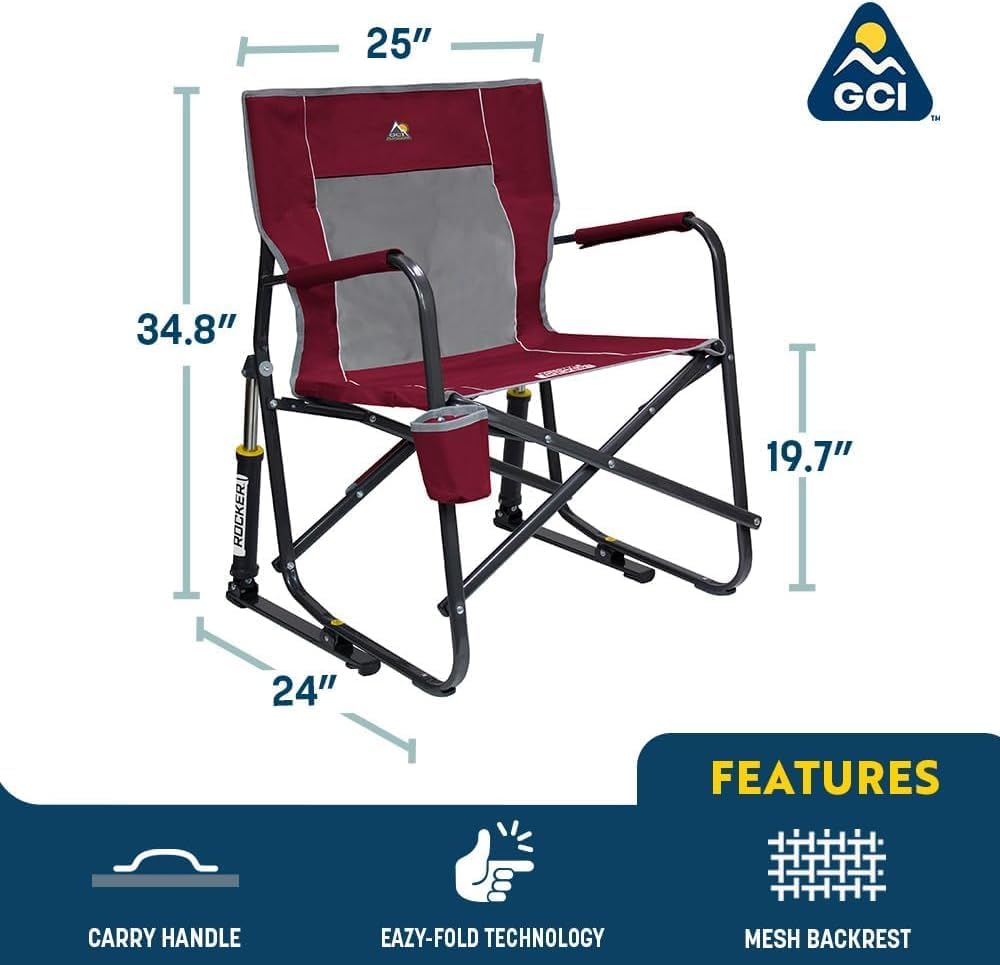
The Freestyle Rocker is the flagship — the chair that put GCI on the map. It’s a full-size folding rocker with a steel frame, a padded seat, and armrests. Manufacturer-rated capacity sits at 250 lbs. Packed, it folds into a carry bag and weighs roughly 9.5 lbs depending on colorway. Retail price typically runs $80–$100, though seasonal discounts at REI and major outdoor retailers have pulled it to the mid-$60s during spring sales.
Owners consistently report that the seat height (~17 inches off the ground) works well for adults of average height without making it hard to stand up — a common complaint with ultra-low camping chairs. The wide padded armrests get called out repeatedly in aggregated reviews as genuinely comfortable for long sits. The tradeoff: at nearly 10 lbs, it’s not a chair you’re adding to a backpacking kit. It’s a car-camping chair, and it’s sized accordingly.
GCI Outdoor Freestyle Rocker XL
The Freestyle Rocker XL is the big-person variant. The frame is wider, the seat is deeper, and the weight capacity jumps to 350 lbs per manufacturer specs. It’s heavier — roughly 12 lbs — and the packed size is larger. Price runs $110–$130 at full retail.
Reviewers at Gear Junkie note that the XL doesn’t just serve larger-framed users; it’s also popular among campers who prefer a roomier sit or who are wearing heavy base layers and don’t want to feel wedged in. The weight penalty is real though: if you’re already juggling a loaded roof rack or tight truck bed, the extra 2–3 lbs over the standard Freestyle adds up across a gear list.
GCI Outdoor Outdoor Master Rocker Chair
The Outdoor Master Rocker is GCI’s step-up model — built with a more rigid frame, higher-grade fabric, and a cupholder integrated into one armrest. Weight capacity holds at 250 lbs, packed weight is similar to the standard Freestyle (roughly 9–10 lbs), but retail price climbs to $120–$150. The main upgrade over the base Freestyle is durability: the Outdoor Master uses a more robust locking mechanism and heavier-duty fabric that owners in long-run reviews describe as holding up better after multiple seasons of real use.
If the standard Freestyle is a reliable everyday driver, the Outdoor Master is the version you buy when you want to stop replacing chairs every two or three years.
GCI Outdoor Rocker Camping Chair (Compact / Slim Models)
GCI also produces slimmer, lighter rocker variants — sometimes listed as the Slim-Fold Rocker or similar — that sacrifice seat width and padding to drop packed weight below 6–7 lbs and retail under $70. These are better for campers who are weight-conscious but not quite committed to a true ultralight setup. Clever Hiker’s ultralight camping chair guide notes that once you’re genuinely counting grams, you’re probably in a different category entirely (think Helinox or similar), but for campers who want “lighter than a full-size chair without going full backpacking mode,” the slim GCI variants occupy a useful middle ground.
By the Numbers: GCI Rocker at a Glance
| Model | Weight Capacity | Packed Weight | Approx. Retail |
|---|---|---|---|
| Freestyle Rocker | 250 lbs | ~9.5 lbs | $80–$100 |
| Freestyle Rocker XL | 350 lbs | ~12 lbs | $110–$130 |
| Outdoor Master Rocker | 250 lbs | ~9–10 lbs | $120–$150 |
| Slim/Compact Rocker | 250 lbs | ~6–7 lbs | $60–$75 |
Specs sourced from GCI Outdoor published product pages; retail pricing reflects May 2026 market conditions and may vary by retailer.
Where GCI Rocking Chairs Win — and Where They Fall Short
The Strong Case For Them
The rocking motion isn’t a gimmick. REI’s camp chair selection guide points out that the rocking function serves a real ergonomic purpose: it lets you shift your weight without standing, which reduces fatigue on long campfire evenings and helps with lower back pressure that flat chairs tend to create after 45–60 minutes of sustained sitting. Owners consistently report that once they’ve camped with a GCI rocker, static chairs feel noticeably uncomfortable by comparison.
The durability story is also solid for the price tier. Wirecutter’s camping chair testing notes that folding chairs in the $80–$150 range frequently fail at pivot points and fabric stress points within 1–2 seasons of heavy use. Across aggregated reviews, GCI rockers — particularly the Outdoor Master — trend toward 3–5 seasons of regular use before meaningful wear appears, which holds up reasonably well against competitors at similar price points.
The Honest Tradeoffs
Weight is the main issue. At 9–12 lbs, GCI rockers are heavier than comparable non-rocking camp chairs (most good non-rocking chairs in the $60–$100 range weigh 5–7 lbs). The Spring Action mechanism adds mechanical complexity that translates directly into grams. For overlanders and car campers with unlimited cargo space, this doesn’t matter. For anyone with a weight budget — canoe trippers, van lifers tight on space, backpackers doing car-accessible hike-in sites — this is a real cost.
Flat-surface dependency is worth naming. GCI’s Spring Action rocking works on hard-packed dirt, gravel, concrete, and wood. On soft sand or uneven terrain with rocks and roots, the mechanism can feel unstable or the rocking range becomes inconsistent. Owners on camping forums consistently flag this as a limitation on beach sites and heavily wooded backcountry spots with uneven ground.
The seat depth on the standard Freestyle skews toward average-height adults. Taller campers (6’2” and above) occasionally report feeling a little upright in the standard model — the XL addresses this, but only by adding weight and cost.
How GCI Stacks Up Against the Alternatives
The honest comparison set here is not Helinox or ultralight chairs — those serve a different use case (backpacking-adjacent, weight-obsessed). GCI’s real competition is other car-camping chairs in the $60–$150 range.
vs. ALPS Mountaineering King Kong Chair (~$80–$90): The King Kong is heavier and doesn’t rock, but it has a 600-lb capacity and is nearly indestructible. If longevity and load capacity are your primary variables and rocking doesn’t matter, ALPS wins on pure durability at a similar price.
vs. Kijaro Dual Lock Chair (~$50–$70): Lighter, cheaper, no rocking. A reasonable budget pick for casual campers who prioritize portability over the rocking experience.
vs. Helinox Chair One (~$200–$230): A completely different philosophy — ultralight (2.1 lbs), small packed size, designed for backpacking trips where every ounce counts. No rocking. For overlanding or base-camp car camping, the Helinox is overkill on price and underkill on comfort-per-dollar. GCI wins that comparison cleanly.
Gear Junkie’s rocking chair review roundup places the GCI Freestyle as the category leader specifically because it offers the most rocker-for-dollar of any mainstream option — a judgment that aligns with the aggregated owner review pattern across major outdoor retailers.
The Decision Rule: Which GCI Rocker Should You Buy?
Here’s the honest “if X, then Y” framework before you commit:
If you’re a car camper or overlander with no meaningful weight budget and you want the best all-around rocking chair experience: Buy the Outdoor Master Rocker. The durability bump over the standard Freestyle is worth the extra $30–$40 over the course of multiple seasons, and the cupholder is genuinely useful. This is the version worth the splurge.
If you weigh more than 250 lbs or simply prefer a roomier seat: Go straight to the Freestyle Rocker XL. Don’t fight a chair that doesn’t fit your frame — the XL solves that cleanly.
If budget is the primary constraint and you can live with lighter construction: The standard Freestyle Rocker at $80–$100 (or on sale in the $60s) gets you 90% of the GCI experience for less money. Strong starting point for a first-time buyer.
If you’re weight-conscious but committed to rocking: Look at the slim/compact variants under $75. You’re giving up seat width and padding, but you’re saving 3 lbs on packed weight — meaningful if you’re juggling cargo space.
If you’re backpacking or doing serious hike-in camping: GCI rockers are not for you. Spend the money on a Helinox or similar ultralight chair and skip the rocking entirely. The weight penalty doesn’t make sense outside of car-accessible sites.
One last note on timing: GCI Outdoor chairs typically see their best pricing in late spring and early fall as retailers cycle inventory. If you’re reading this in May 2026 and a sale is live, it’s worth pulling the trigger now rather than waiting for summer peak prices. The rocking motion is the kind of thing that, once experienced at a campsite, becomes genuinely hard to give up.